Showing posts with label Bulb. Show all posts

Friday, July 17, 2015

Galanthus - The Snowdrop


Terrible weather lately has kept many people inside this winter. Of course the weather is really bad at the weekend and sometimes quite fine during the week when we are all at work.


Galanthus - The Snowdrop

At this time of the year the true snowdrops are flowering. This small plants should not be confused with the larger and more popular Snowflakes that flower later.

Galanthus are found in the wild throughout Europe and the Mediterranean. There are 20 species in the genus. They have been cultivated from many years and many species and forms provide an interesting display in the garden when there is nothing else in flower. They do best in cool climates.

Galanthus byzantinus from southern Europe is one of the best species. Its wide, long deep green leaves which set off the white, globular flowers held aloft on longer stems.

Galanthus caucasicus is quite desirable and flowers earlier than the others. It has large rounded white flowers

Galanthus elwesii is one of the best snowdrops. It produces several stems of white flowers with green markings on the petals.

Galanthus nivalis is the most common species and there are several cultivars. Single white flowers tipped with green are borne on the stems in early spring.

Galanthus plicatus has very large flowers with prominent green markings around the inner segments and it flowers later. 

Further reading
https://en.wikipedia.org/wiki/Galanthus

Friday, April 3, 2015

Colchicum speciosum


Farrar in his book ‘The English Rock Garden’ describes this plant as “one of the most noble and beautiful plants in the world”. Flowering in April its formal upright elegant shape is an impressive sight just as winter approaches.
 Colchicums are often called ‘Autumn Crocus” but they are no relation to true crocus which belongs to the family Iridaceae (Iris Family) and Colchicum belongs to the Lily Family (Liliaceae). The quick reference to identify the difference is to count the number of stamens. Crocus has three and Colchicum has six.

The name Colchicum is derived from Colchis the ancient name for the Black Sea Region which includes Caucausus, Northern Turkey, Iran and Asia Minor. The various species can be found growing from sea level to 2000 metres on the Mountain slopes.

C. speciosum produces the largest flowers of all Colchicums. These giant tulip like cups are carried noblely on strong, elegant stems up to 300mm high. Within this species flower colour varies between deep crimson and rich lilac but in all cases they have a white base. They remain upright longer than other species. All colchicum are nudifloral plants which means they flower before leaves appear.

 After flowering in April/May strong wide leaves appear and grow right through until January when they die off. In summer the bulbs like to be hot and dry which aids future growth and flowering.

The corms are larger strong irregularly shaped and covered by a strong dark brown tunic. They divide readily and like to naturalise in good soil. If they get too crowded the quality of the flowers deteriorates. They should be dug and divided at this stage. Colchicums prefer good drainage and like to experience cold winters and hot summers.

These are several varieties and hybrids of C.speciosum. 

C. speciosum “Album” is a large pure white goblet with a green stem. It is an exceptionally beautiful flower especially in the gloom of autumn.


“The Giant” is hybrid which has large lilac flowers and a white stem.


An excellent account of Colchicum can be found in EA Bowles 1952 book ‘A Handbook of Crocus and Colchicum for Gardeners’ for those interested in obtaining more information.


Sunday, December 14, 2014

Cardiocrinum giganteum - Giant Himalayan Lily

Cardiocrinum giganteum - Giant Himalayan Lily, Giant Yunnan Lily, Giant Lily


This is one of the largest lilies in the world and one of the most spectacular when grown en mass. It is a woodland plant from the Himalayas and grows very successfully in New Zealand. The largest naturalised area is at Mt Peel Station homestead near Geraldine. Large groupings can be established where bulbs of all ages produce a regular cycle of blooming plants each year.

It prefers partial shade and deep rich moist soil. The very large bulbs should not be planted to deep but rather just under the surface of the soil. When established the bulb sits with part of the bulb out of the ground. The bulb consists of just a few highly succulent bulb scales. It may obtain a diameter of about 20 cm. Plants are fully hardy and adore light shade, humidity and rich, leafy soils. Prepare soil well in advance with plenty of humus, leaf mould, manure and bark to get the best from them.

The large, tall, 50mm thick, stately flower spike can easily reach 3 metres in height and carry up to 40 pendulous trumpet shaped flowers. The flowers are a creamy yellow white with maroon/claret stripe and markings at the base of the flower in the throat and have a lovely vanilla scent. Flowering in December in New Zealand they are held well above the green foliage which often has a bronze/purple tinge in sunnier situations. A showstopper.


The middle flowers of the raceme open first. The buds are oriented perpendicular to the stem in an upright position on the raceme while the flowers are forming but later as they open they change to become hanging. After flowering the fruit stalk increases in length and bend upwards again to a position similar to that of the buds carrying the rounded upright seed pods. The seed is viable and will produce more young plants. 

The bulb that flowered dies soon after setting the next crop of seed. Flowering is continued by the new young bulbs growing as offsets. The leaves are very large, heart shaped, bright green and glossy arranged around the bulb and up the stem. The foliage may take on a purplish hew in sunnier dryer locations.

Planting the bulbs in groups is one way to get a longer flowering period as the flowers do not last a long time. Additionally once flowered the bulb dies (it is monocarpic) as it has used up all its energy and the offsets around it grow to flower in future years. Therefore a series of bulbs of different ages ensures some will flower each year.

The flowers produce enormous toothed seed-pods when dried and grows very well from seed collected in New Zealand. It will take more than five years for the bulbs to flower from seed. Small offsets on the side of the bulbs can be removed, planted  up to 80cm apart and easily grown in good soil in light shade. They may flower in three years. Planting in successive years or in different sizes ensures a cycle of flowering. 


If growing from seed sow as soon as possible indoors and outdoors at any time of year. Keep the seeds in the fridge until you are ready to sow. Sow seeds in a pot of peaty compost at a depth of around 2mm and cover them with fine gravel or grit. The gravel holds the seeds in place and keeps the moisture at the soil surface. 

Put in a cool dark place. Artificial heat is not needed and in some cases will prevent the seeds from germinating. Germination can be very slow, the seeds often need two periods of cold moist conditions with a warm growing period in between. The seeds should germinate in spring but may germinate in their second year, so patience is needed. Keep the compost moist at all times and, if needed clean the tray, replacing the grit in the second year. 

Allow the seedlings to grow in a shaded place and protect them over the following winter. The new plants can be put into the garden in spring.

In the autumn when you remove the dead stem and the seedpods, separate the bulblets and replant them in a permanent location (70 to 90cm apart). The bulbs need to be separated and spread out to prevent overcrowding to ensure that each achieves its maximum growth potential. They will bloom in three to five years. From one bulb you can eventually get a sizeable group of plants. 

Woodland settings are ideal. These lilies need a shady location where direct sun will not sunburn their leaves. Filtered shade works if the roots are protected with mulch. Hot summer temperatures may cause die-out. Bulbs are hardy with winter mulch. Larger trees and shrubs also protects them from strong winds that might break their flowering stems or knock them over.

Soil should be loose and moisture-retentive but well-drained and rich in nutrients. Standing water rots the bulbs. As they are heavy feeders, give them lots of compost and leaf mould and supplement this with slow release organic fertiliser in spring. Where possible, site them where they can be viewed from a distance as a group rising from a low border. Since their leaves are not attractive in late summer and autumn (slug damage), keep them away from the front of the beds. Woodland ground covers help hide decaying foliage. 


Combine Cardiocrinum with companions that like similar conditions. Rhododendrons, camellias, azaleas and hydrangeas are good backgrounds. Also, true lilies, astilbes and primulas. Once the bulbs have become established and begin to enlarge, cardiocrinums resent being moved. If moved, they tend to become stunted, so pick the right spot the first time.

Garden snails eat the young growing leaves and small holes will turn into large holes when the leaves are mature. Snails can be kept away from the young leaves with a ring of garlic-paste around the base of the plant or use organic slug bait.

Botanically there are two varieties of  Cardiocrinum giganteum noted in the Flora of China 
C. giganteum var. giganteum which grows to 3 metres tall, has the outer part of the flower greenish and the inside streaked with purple, and
C. giganteum var. yunnanense which is shorter, and has the outer part of the flower white and the inside streaked with purplish red

It is C. giganteum var. giganteum that is most commonly cultivated.

Cardiocrinum is a small genus in the lily family (Liliaceae). Though closely related to true lilies (Lilium), one distinguishing feature separating the genus Cardiocrinum from the genus of true lilies is its notable wide heart-shaped leaves with branched veins (true lilies have strap-shaped leaves). The large leaves of Cardiocrinum give rise to its genus name. It derives from the Greek words kardio for heart and krinum for lily - meaning 'heart lily’.

There are three species of the genus Cardiocrinum grown in cultivation and can be found for sale - Cardiocrinum cordatum, C. giganteum and C. cathayanum.

C. giganteum was first described scientifically by Nathaniel Wallich in Nepal and was introduced into commercial production (as Lilium giganteum) in Britain in the 1850s. A bulb grown from seed collected by Major Madden flowered in Edinburgh in July 1852, while those collected by Thomas Lobb were first exhibited in flower in May 1853. 

It originates from forest floors in the Himalayas of India, Tibet, Nepal, Bhutan, Pakistan, China and Myanmar (Burma).

Cardiocrinum giganteum is a fantastic plant in all respects, but they are a long term project but need little effort and maintenance other than pricking out from germinating and potting on. This rare beauty is well worth the wait.

References From the Web.

Wednesday, March 7, 2012

Cyclamen hederifolium


This hardy species of Cyclamen has a wide distribution stretching from southeastern France, through Italy, Corsica, Sardinia, Sicily, Croatia, Bosnia, Serbia, Albania, Bulgaria, Greece, (including Crete and many of the Aegean Islands) and western Turkey. It inhabits woodland, scrub, and rocky hillsides from sea level to 1300m.

C. hederifolium has pink flowers with a purple-magenta V-shaped blotch at the base of each petal, which appear between January and May in New Zealand. There is also a white flowered form which is now common in cultivation, but scarce in the wild. The many flowers appear either before, or with, the young leaves which are often ivy-like as suggested by the specific epithet. However, the plant is very variable and the leaves can be every shape from almost orbicular to lanceolate. Leaves vary from dull or bright plain green to plain silver with various forms of pattern in between, with the pattern in silver, gray, cream or merely a different colour green. The tuber roots from its top surface and sides.
The plant was for many years known in horticulture as Cyclamen neapolitanum Ten. (1813), and this name erroneously persists today in some nurseries and writings although the name Cyclamen hederifolium Aiton was proposed in1789. Today its correct name is Cyclamen hederifolium.

In 1997, Grey-Wilson revised the classification of the species, identifying two varieties. This recognised that populations in the southern parts of its range, particularly Sicily, Crete and the Mani Peninsula of the Peloponnese differ from other forms.

C.hederifolium var. hederifolium. Which has two forms  C. hederifolium var. hederifolium forma hederifolium which has  prominent patterns on the leaves and deep pink to reddish purple flowers and C. hederifolium var. hederifolium forma albiflorum with pure white or pale pink flowers

C.hederifolium var. confusum. Which has leaves bright green with a poorly defined leaf patterns, leaves thicker and fleshier, shiny, particularly beneath.

C.hederifolium is the most reliable and hardy Cyclamen species, flowering well in the garden and seeding around. It grows well both in full sun and partial shade or beneath deciduous trees. It particularly enjoys growing in soil which contains a good proportion of leaf mould (leaf litter). It easily survives low temperatures, and grows quite happily in  in New Zealand. It naturalises in a variety of areas making a fine show.

The fleshy tubers can survive for up to 50 years in the ground and can grow up to the size of a saucer.

Some cultivars have also been named C.hederifolium.'Album', C.hederifolium 'Pink Pearl' and 'White Pearl'

For more information on the 20 species of Cyclamen visit http://www.cyclamen.org. This is the website for the Cyclamen Society.

Wednesday, April 27, 2011

Nerine bowdenii. Cape flower, Guernsey lily, Japanese spider lily


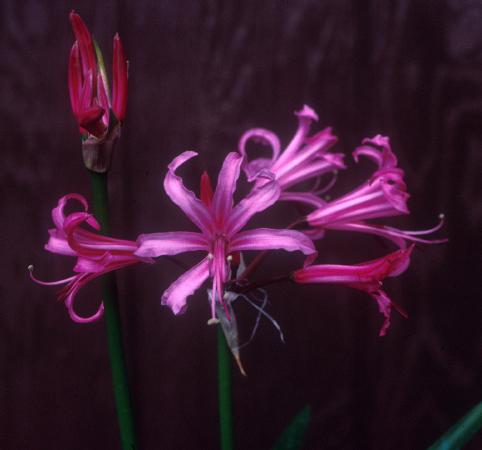
The bright, pink flowers of Nerines always add that little extra in the garden at this time of year when the demise of summer colour is well on its way. Whether it is pink, white or bright orange-red it always is nice to see before the onset of winter.

The genus Nerine, which belongs to the Amaryllidaceae, is made up of small to medium sized bulbous plants. They are all native to South Africa, and there are 20 to 30 species that originate from rock ledges, mountain screes, mountain ledges and other well-drained and arid habitats where the soil is not too rich. Most occur in the summer-rainfall areas, from the Eastern Cape Province north and eastward. In New Zealand they are quite hardy but in England and other countries with tougher winter climates they are considered to be tender and they are grown in pots.

Nerine bowdenii is native to the KwaZulu-Natal Drakensberg and Eastern Cape Province. It is a summer-growing species which flowers in the autumn and is deciduous in winter. The large, 50mm pink, trumpet shaped flowers are borne in an umbel of up to 10 blossoms atop a scape (stem) 25 to 50cm tall. There are also occasional white-flowered forms. Its frost-hardiness stems from the fact that it grows at up to 3000m. elevation in parts of the Drakensberg.

Nerines are related to Brunsvigia and less closely to Crinum and Amaryllis (the Cape Belladonna). The bigeneric hybrid between Brunsvigia and Nerine is called Brunserine. Some Nerine species are confused with Brunsvigia, or perhaps vice versa.

N. bowdenii is the only contender hardy enough for consideration in cold climates. They resent disturbance and produce their best display of flowers when the bulbs appear to be overcrowded. Resist the temptation to lift and divide clumps of bulbs, as it may be a few years before they produce a vigorous display of flowers.

There isn’t a widely used common name for this genus, but the flowers are so distinct and the botanical name is concise enough for it not to cause a problem. Occasionally, it is referred to as the Guernsey lily as there is evidence that it was, at one time, naturalised in the Channel Islands. Nerine sarniensis, or the Guernsey lily, was named when a ship was wrecked many years ago on Guernsey, the second largest of the Channel Islands, located off the coast of Normandy.  Nerine bulbs washed ashore and took root on the island's sandy beaches.  Because the ship was Japanese, it was originally believed that they were Japanese in origin, hence another of the common names, Japanese spider lily, but they are actually native only to South Africa.

The genus is named from the Greek word Nereis, the name of a sea-nymph. Perhaps a reference to the bulbs that were washed up onto the Channel Islands.

At their best, the long-lasting flowers have an extremely exotic appearance.

N. bowdenii is also suited to growing as a greenhouse bulb, but flowers stems can become elongated and require staking in this situation.

Until recently, pink was the predominant colour, but frenetic hybridising, especially in New Zealand, has produced a wide range of Nerine colours. Flowers are now available in shades of scarlet, magenta, fuchsia, blush pink and orange, and recent introductions include those with grey, white, bicoloured or striped flowers. Although some of those colours may be slightly more subdued than the typical shocking pink Nerines can be relied upon to add an unusual and extroverted dimension to the autumn garden.

An interesting aspect of the culture of nerines is that many of the species do not need much fertilizer. Hybrids involving N. sarniensis and N. bowdenii in particular may show signs of something like a virus infection if fertilized too much.

This robust perennial is one of the best late flowering bulbs.  In the autumn it bears open sprays of five to ten trumpet-shaped, faintly scented, bright pink flowers with curled, wavy-edged petals.  The strap-like, glossy green leaves appear after the flowers, at the base of the plant.  In the garden it is suited to a dry position, at its best where it is bright and sunny where the vivid and distinct flowers can be shown off to their best in May. 

Like many herbaceous perennials and bulbs the foliage is often attacked by slugs and snails but otherwise nerines are generally free from pests and diseases.

Propagate from bulblets by dividing the clumps after flowering, or when in leaf in the spring, or propagate by seed, sowing the seed as soon as it is ripe. Seedlings take three to four years to reach flowering size. 

Sunday, May 16, 2010

Haemanthus

Haemanthus
This is an interesting genus of some 20 species of bulbs belongs to the Amaryllidaceae - the Amaryllus family.

Haemanthus coccineus is a fairly common species and is often available to purchase. 

The flowers appear at the top of a 10-15cm erect solid stalk.  The flowers at the top of the stalk have very small petals and it is the clusters of stamen which make this look like a paint filled paintbrush.  It is unusual and interesting.  The masses of orange red stamen each capped with a yellow pollen sack all surrounded by bright red bracts.  The flowers may vary in colour a little if grown from seed. Records show these colours may vary from bright pink to dark red.

H. coccineus is generally evergreen with wide (up to 15cm) flat dull green leaves growing horizontal to the ground.  The leaves are an attraction on their own.

Haemanthus albiflos is a fairly common species and is often available to purchase. 

The flowers appear at the top of a 10-15cm erect solid stalk.  The flowers at the top of the stalk have very small petals and it is the clusters of stamen which make this look like a paint filled paintbrush. H. albiflos produces masses of white or light green stamen each capped with a yellow pollen sack all surrounded by green bracts. 

H. albiflos is generally evergreen with wide (up to 8cm) hairy leaves. It is the only species that multiplies readily from leaf cutting as well as by division.

If you can get hold of these plants try growing them

Tuesday, May 11, 2010

Can you name this plant? Its Haemanthus


This autumn flowering bulb has very large leaves

The above are two species of the same genus

Have a go and please leave a comment

Thanks for the comments


Tuesday, April 13, 2010

Crocus sativus. Saffron


A lovely little crocus that flowers in autumn. It is no relation to the Autumn Crocus Colchicum.
Its claim to fame is that it is the source of saffron and it is harvested in autumn from these lovely little plants. The long, drooping stigmas of brilliant orange/scarlet are the source of saffron. They are painstakingly harvested by hand and dried to be used as a herb in cooking as a seasoning and colouring agent. Saffron, long the world's most expensive spice by weight, is native to Southwest Asia.

The domesticated saffron crocus (C. sativus) is an autumn flowering bulb unknown in the wild. It is a sterile triploid form, possibly of the eastern Mediterranean autumn-flowering C.cartwrightianus that originated in Crete.  The saffron crocus resulted when C. cartwrightianus was subjected to extensive artificial selection by growers seeking longer stigmas. Being sterile, the plant's purple flowers fail to produce viable seeds; reproduction depends on corms underground bulb-like starch-storing organs, being dug up, split and replanted.

The corm sends up five to eleven narrow and nearly vertical green leaves, each up to 40 cm  in length. In autumn, purple buds appear and its brilliantly hued flowers develop; they range from a light pastel shade of lilac to a darker and more striated mauve.  A three-pronged vivid orange crimson style about 300mm long emerges from each flower.

The plants grow poorly in shady conditions; they grow best in strong sunlight. Planting is best done in fields that slope towards the sunlight maximizing sun exposure. Planting depth and corm spacing are critical factors affecting yields. Mother corms planted deeper yield higher-quality saffron, though from fewer flower buds and daughter corms.

C. sativus prefers friable loose, low-density, well-watered, and well-drained clay soils with high organic content. Traditional raised beds promote good drainage. Soil organic content was historically boosted via application of some 20–30 tonnes of manure per hectare.  After a period of dormancy through the summer, the corms send up their narrow leaves and begin to bud in early autumn. Only in mid-autumn do they flower. Harvesting the saffron has to be rapid as after blossoming at dawn, flowers quickly wilt during the day.  All plants bloom within a window of one or two weeks.  Roughly 150 flowers yield 1 gram of dry saffron threads.

Sunday, April 11, 2010

Can you name this plant?

Have you seen this plant in cultivation?
Hint: It is grown commercially and it is autumn in NZ


Leave a comment telling others about the unique qualities of this plant.

Please leave a comment

After a few days I will post a short article on this plant.


Sunday, February 14, 2010

Cyclamen hederifolium


Mid February is near the end of our official summer of December, January and February. The weather is really supposed to be hot but this year is a very cool summer for us. Usually our best months are Late January to mid March. 

The photos show the gradual emergence of the cyclamen flowers from one very large cyclamen corm and  a photo of my single white flower currently out.


Cyclamen hederifolium
This is one of the easiest species of hardy cyclamen to grow outside in your home garden. Once established and it flowers well it will set seed and more plants may grow nearby. It makes a great ground cover and produces many flowers often at a time when other flowers have finished.

This hardy species of Cyclamen has a wide distribution stretching from southeastern France, through Italy, Corsica, Sardinia, Sicily, Croatia, Bosnia, Serbia, Albania, Bulgaria, Greece, (including Crete and many of the Aegean Islands) and western Turkey. It inhabits woodland, scrub, and rocky hillsides from sea level to 1300m.

C. hederifolium has pink flowers with a purple-magenta V-shaped blotch at the base of each petal, which appear between January and May in New Zealand. There is also a white flowered form which is now common in cultivation, but scarce in the wild. The many flowers appear either before, or with, the young leaves which are often ivy-like as suggested by the specific epithet. However, the plant is very variable and the leaves can be every shape from almost orbicular to lanceolate. Leaves vary from dull or bright plain green to plain silver with various forms of pattern in between, with the pattern in silver, gray, cream or merely a different colour green. The tuber roots from its top surface and sides.
The plant was for many years known in horticulture as Cyclamen neapolitanum Ten. (1813), and this name erroneously persists today in some nurseries and writings although the name Cyclamen hederifolium Aiton was proposed in1789. Today its correct name is Cyclamen hederifolium.

In 1997, Grey-Wilson revised the classification of the species, identifying two varieties. This recognised that populations in the southern parts of its range, particularly Sicily, Crete and the Mani Peninsula of the Peloponnese differ from other forms.

C.hederifolium var. hederifolium. Which has two forms  C. hederifolium var. hederifolium forma hederifolium which has  prominent patterns on the leaves and deep pink to reddish purple flowers and C. hederifolium var. hederifolium forma albiflorum with pure white or pale pink flowers

C.hederifolium var. confusum. Which has leaves bright green with a poorly defined leaf patterns, leaves thicker and fleshier, shiny, particularly beneath.

C.hederifolium is the most reliable and hardy Cyclamen species, flowering well in the garden and seeding around. It grows well both in full sun and partial shade or beneath deciduous trees. It particularly enjoys growing in soil which contains a good proportion of leaf mould (leaf litter). It easily survives low temperatures, and grows quite happily in  in New Zealand. It naturalises in a variety of areas making a fine show.

The fleshy tubers can survive for up to 50 years in the ground and can grow up to the size of a saucer.

Some cultivars have also been named C.hederifolium.'Album', C.hederifolium 'Pink Pearl' and 'White Pearl'

For more information on the 20 species of Cyclamen visit http://www.cyclamen.org. This is the website for the Cyclamen Society.


Thursday, January 28, 2010

Lilium lancifolium Tiger Lily

Lilium lancifolium (L. tigrinum) Tiger Lily, Devil Lily, Kenten.


Lilium lancifolium Tiger Lily


L. lancifolium ‘Flore Pleno’

The botanists are still fighting over its correct name but I think this name Lilium lanciflorum is winning. However many people will know this plant a Lilium tigrinum or Tiger lily. It has also had an earlier name L.sinense (Nois ex Stead).

It is also believed to be a very old and ancient hybrid between Lilium maculatum and L. leichtlinii. It has been described as lily in cultivation in the world. This botanical investigation is backed up by modern science as its chromosome numbers identify it as a triploid. This makes it a vigorous plant and because of its triploid nature it does not produce seed.

A native of China, Japan and Korea it is found growing in a number of locations and soil types but it does not like lime or limestone areas. In the wild the flowers vary in colour from a dark yellow to a dark orange with purple or black spots on the petals. In these countries the bulbs were consumed as food up to 1000 years ago.

Its does not like lime soils and in ideal soils and poor soils without lime it will quickly naturalise large areas quite quickly. In Britain it is heavily infected with a virus but still manages to naturalise large areas. It is recommended not to grow this lily in close proximity to other lilies as the virus will spread to them as well.

It is easy to grow and forms a large bulb and the new stems grow rapidly each year up to abut 1.5 metres tall. Long narrow lanceolate leaves protrude from the stem. Depending on location and parentage of the clone they can be quite hairy with lots or a little of white cobwebby long hairs on the stem and leaves. Set at the base of the leaves is a small bulbil which can be planted in the ground to rapidly increase this plant.

It is widely grown and depending upon size can produce up to 25 flowers in a head born on black stems. The most common colour is deep bright orange petals and sepals heavily marked with dark purple spots. The pollen is purple brown in colour. Some clones will be a little softer in colour.

This bold display of flowers appears in NZ in January. They hang from stems and have reflexed petals (and sepals) creating a nodding Turks Cap flower.

There are a few cultivars grown in gardens

L. lancifolium ‘Flore Pleno’ (l.l. Florabunda) which has large double flowers.
L. lancifolium ‘Giganteum’ a larger growing form
L. lancifolium ‘Splendens’  with large glossy flowers of a rich salmon red colour.
L. lancifolium var flaviflorum a yellow purple spotted form which does set seed.
L. lancifolium var. fortunei with densely woolly stems
L. lancifolium var. simplex a single flowered form
L. lancifolium var. plenescens which has six series of petals and sepals.

This easy to grow lily makes a fine show in mid summer in any garden. It will increase and naturalise quickly.

Thursday, January 14, 2010

Littonia modesta. Climbing Lily, Climbing Bell.


If you are looking for a neat bulb that is different then Littonia might be for you. A native of Natal, South Africa, this is a genus of seven species closely related to Gloriosa and belongs to the Colchiaceae a division of the former large family Liliaceae.

Beautiful foliage of a fresh soft green colour adorns the green stems and the leaves are arranged alternately, opposite and whorled all on the same stem.
Unlike lilies the stems keep growing after the flowers have finished and may reach up to 1.8metres high. It climbs by tendrils attached to the end of the leaves and they will wrap around most plants or climbing frames.

Flowers are a true golden yellow colour bell shaped about 5 cm across solitary in leaf axils, the six hanging petals are pointed. Usually there are five flowers per stem and they are good for picking.

After flowering large green seed pods appear which eventually split to produce large red brown, pea sized, seeds. Sow the seed normally but be aware it can stay dormant for a few years as it has adapted to the variable South African climate. The new tubers will take 2 -3 years to flower.

It was named after Dr Litton a Professor of Botany at the University of Dublin Ireland and introduced to England in 1853.

Easily grown in normal garden conditions with drained soil for its unusual forked bulbs to grow in, but if the ground is not well drained lift and store the bulbs in winter.

In South Africa the cultivar Littonia modesta ‘Keitii’ produces large and more flowers per stem and is a stronger plant.

In New Zealand it has been crossed with Sandersonia to create a bigeneric cross XSantoina ‘Golden Lights’ which is being evaluated for  the cut flower market.

Monday, January 11, 2010

Plant spotting


Sandersonia aurantiaca Gold Lily of the Valley

A neat summer flowering bulb which has a slight tendency to naturalise in the garden. I would not be without it. While its common name is Gold Lily of the Valley it is nothing like the traditional Lily of the Valley of spring.

Growing from a very odd shaped bulb this is the only species of this genus. It naturally occurs in South Africa and is allied to Gloriosa and Littonia. It has been known to hybridise with these two plants and they all belong to the lily family.

It requires a loose, free soil ands a sunny sheltered spot and freedom from heavy frosts. (In Christchurch NZ we get ground frosts of -8C and there is not effect).

The stems grow vertically about 300 -450mm high each bearing up to 7 individual lantern shaped orange/yellow flowers branching out on single pendant stems from the axil of the leaf and stem. It quickly sets viable seed which grows very well.

It is commonly grown commercially fro cut flowers in NZ for both the domestic and export market.

Saturday, December 26, 2009

Plant Spotting


Regal Lily
Christmas Lily in New Zealand as it flowers right on Christmas day each year.

Tuesday, May 5, 2009

Nerine


Nerine filifolia


Nerine flexuosa ‘Alba’

Nerine flexuosa ‘Alba’
In May each year this small Nerine produces a lovely display of white flowers. While it grows well and multiplies freely it is not as common in gardens as it could be.

At this time of year a plant which is in full flower is important. Planted in full sun it requires little care other than cleaning the bulbs by removing some of the old dead leaves ensuring the summer sun reaches the bulbs t make sure they will flower. Autumn watering will help establish their roots so that new bulbs are produced and the older ones have their energy renewed.
The genus Nerine, which belongs to the Amaryllidaceae, is made up of small to medium sized bulbous plants. They are all native to South Africa, and there are 20 to 30 species that originate from rock ledges, mountain screes, mountain ledges and other well-drained and arid habitats where the soil is not too rich. Most occur in the summer-rainfall areas, from the Eastern Cape Province north and eastward. In New Zealand they are quite hardy but in England and other countries with tougher winter climates they are considered to be tender and they are grown in pots.

Nerine filifolia


This is a tiny little nerine with grass like foliage and thin spidery rose pink flowers. It is excellent for those small intimate spaces in the garden and looks particularly good when grown adjacent to a large rock, urn or something with a plain surface to show off its fine detail.

Sunday, March 1, 2009

Colchicum speciosum


Farrar in his book ‘The English Rock Garden’ describes this plant as “one of the most noble and beautiful plants in the world”. Flowering in April its formal upright elegant shape is an impressive sight just as winter approaches.

Colchicums are often called ‘Autumn Crocus” but they are no relation to true crocus which belongs to the family Iridaceae (Iris Family) and Colchicum belongs to the Lily Family (Liliaceae). The quick reference to identify the difference is to count the number of stamens. Crocus has three and Colchicum has six.

The name Colchicum is derived from Colchis the ancient name for the Black Sea Region which includes Caucausus, Northern Turkey, Iran and Asia Minor. The various species can be found growing from sea level to 2000 metres on the Mountain slopes.

C. speciosum produces the largest flowers of all Colchicums. These giant tulip like cups are carried noblely on strong, elegant stems up to 300mm high. Within this species flower colour varies between deep crimson and rich lilac but in all cases they have a white base. They remain upright longer than other species. All colchicum are nudifloral plants which means they flower before leaves appear.

After flowering in April/May strong wide leaves appear and grow right through until January when they die off. In summer the bulbs like to be hot and dry which aids future growth and flowering.

The corms are larger strong irregularly shaped and covered by a strong dark brown tunic. They divide readily and like to naturalise in good soil. If they get too crowded the quality of the flowers deteriorates. They should be dug and divided at this stage. Colchicums prefer good drainage and like to experience cold winters and hot summers.

These are several varieties and hybrids of C.speciosum. C. speciosum “Album” is a large pure white goblet with a green stem. It is an exceptionally beautiful flower especially in the gloom of autumn. “The Giant” is hybrid which has large lilac flowers and a white stem.

An excellent account of Colchicum can be found in EA Bowles 1952 book ‘A Handbook of Crocus and Colchicum for Gardeners’ for those interested in obtaining more information.

Sunday, July 20, 2008

Galanthus - The Snowdrop


At this time of the year the true snowdrops are flowering. This small plants should not be confused with the larger and more popular Snowflakes that flower later.

Galanthus are found in the wild throughout Europe and the Mediterranean. There are 20 species in the genus. They have been cultivated from many years and many species and forms provide an interesting display in the garden when there is nothing else in flower. They do best in cool climates.

Galanthus byzantinus from southern Europe is one of the best species. Its wide, long deep green leaves which set off the white, globular flowers held aloft on longer stems.

Galanthus caucasicus is quite desirable and flowers earlier than the others. It has large rounded white flowers

Galanthus elwesii is one of the best snowdrops. It produces several stems of white flowers with green markings on the petals.

Galanthus nivalis is the most common species and there are several cultivars. Single white flowers tipped with green are borne on the stems in early spring.

Galanthus plicatus has very large flowers with prominent green markings around the inner segments and it flowers later.