Showing posts with label Shrub. Show all posts

Friday, October 24, 2014

Cantua – A lot of sacred magic

Cantua is a plant you either love or hate. Sometimes people who grow it both love and hate it. Why? Well it produces some of the most attractive flowers you will ever see on a shrub but the plant itself has a somewhat scruffy appearance.

This plant - "The Sacred Flower of the Incas", or "Magic flower of the Incas" or "Sacred Flower of Peru" is a native of South America and renowned for the beauty of their large flowers. It grows in the wild of the Andes of Peru, Bolivia and Chile. About 12 species are known and they are classified as woody shrubs and trees and, in New Zealand, semi to almost evergreen.

The exotic drooping tubular shaped flowers long from terminal clusters of 6 - 12 flowers on the tips of long branches. 50 - 75mm long the flowers are long colourful tubes opening out like a trombone horn. They vary in colour from light yellow to bright red depending upon species.

They belong to the Polemoniaceae family which also includes a range of herbaceous annuals perennials and a few shrubs. A previous genus name for some species was Huthia.

The leaves are about 25mm long and are of a simple narrow shape. The branchlets are rather gnarled and spiky and look quite scruffy and even untidy.

Cantua tolerate a variety of conditions being drought resistant but survive in cooler moister areas as well. Good drainage is a key to success and they will tolerate cold areas once established. They tend to flower better in full sun with a little shelter.

They are generally easy to cultivate with the main activity being to prune off older stems to keep it young and vigorous. Propagation is by semi hardwood cuttings under normal conditions.

Species and cultivars

C. buxifolia (C. dependens). The most common and most popular species in NZ. Flowers are a brilliant red/pink or may range from purplish rose to cherry red depending upon the seedlings grown. It grows up to 1.5 metres high. Selected cultivars are offered in the USA.


C. bicolor. This is also available and it produces flowers which are tricoloured yellow, red and orange. It reaches about 1.5 metres high.


C. pyrifolia is a rare plant in NZ but produces curved yellow tubular flowers with white lobes.

C. tomentosa. Rare with salmon orange flowers.

C "Vanessa's Gold" A form selected in Nelson by Alan Jolliffe and marketed as "Vanessa's Gold". An excellent strong growing shrub well clothed in foliage and producing lemon yellow flowers several times a year. It grows up to 2 metres high.


Cantua sp. A creamy white form is reported in NZ.

Cantuas are not the prettiest plant in foliage and growth habit but produce these wonderful flowers. The make a great display when in flower. Cantua are best planted in the back of the border where their rather scruffy growth can be hidden by other plants but when in flower they need to be seen. They are excellent garden plants for a variety of situations and when in flower make a talking point.

It is covered with small ovate leaves and it produces bunches of pendulous, funnel-shaped flowers in spring and summer. It will survive in regions that receive little frost. In Christchurch try it in a sheltered place against the wall of a house or garage.


When not in flower the shrub often goes unnoticed. It should be pruned after flowering to encourage new growth and spectacular flowering.

Monday, July 25, 2011

Hamamelis mollis Chinese Witch Hazel


Found by European plant hunter Charles Maries he introduced this plant to England in 1879 and in 1918 the great plant collector E H Wilson introduced some more plants to grow from a different area of China. It is a native of the West Hubei and Kiangsi provinces and grows naturally in scrub and woodland from 1500m to 2500m.

Hamamelis (Greek for pear shaped fruit) is the principal genus of the family Hamamelidaceae which has 20 genera some of which are very hardy and some of which are subtropical. Hamamelis has six different species of which the best is Hamamelis mollis.

This handsome shrub can grow up to 3 metres high but is often less than that in gardens. It is highly valued as a winter flowering plant in colder climates even though it will grow quite well in warmer climates.

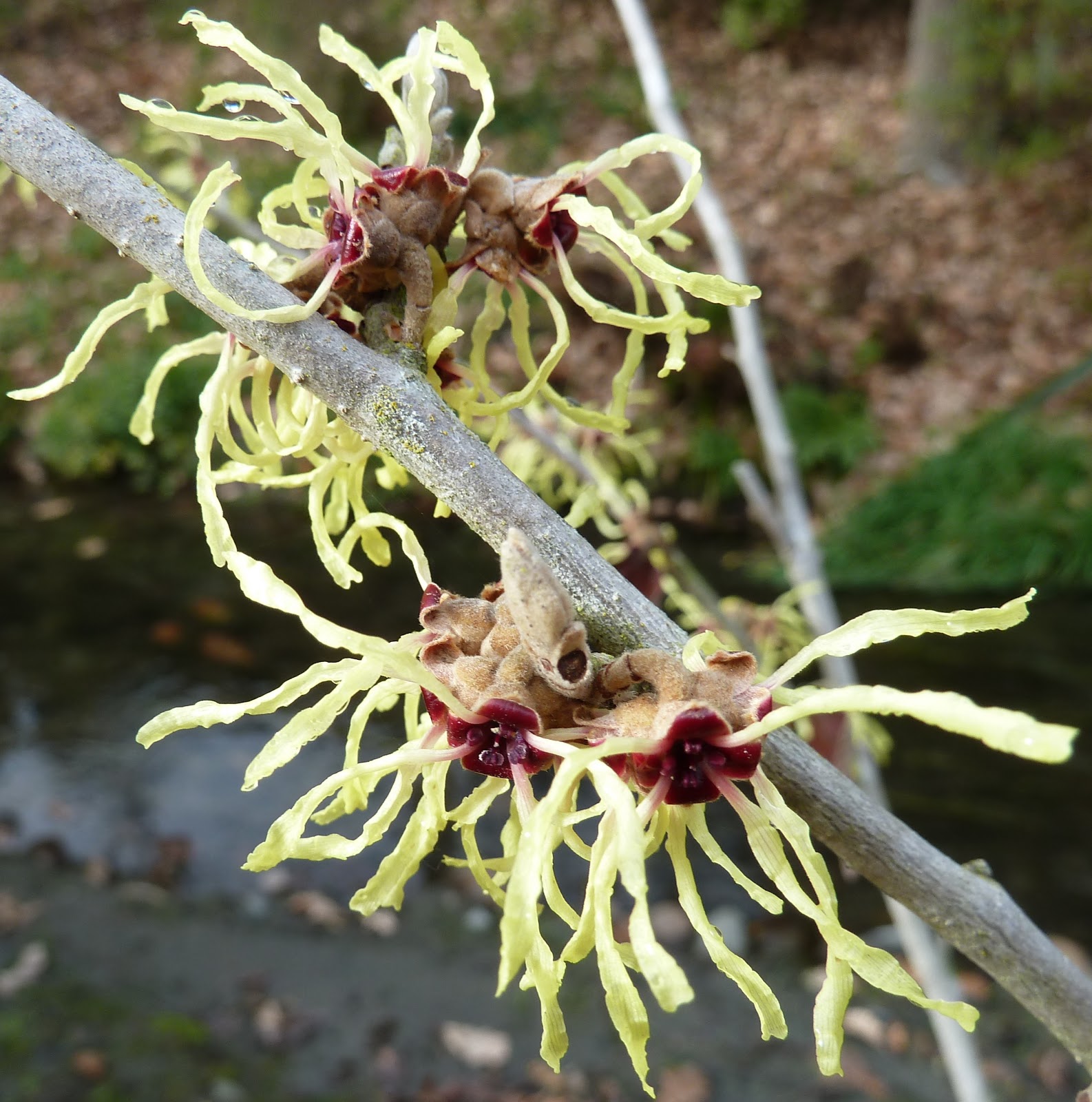
The golden yellow sweetly fragrant, flowers, which grow in small clusters, are made up of 4 separate narrow strap like petals arising from a maroon coloured base (receptacle) that can withstand frosts up to -20C. When grown from seed there is some variation in colour of the flowers. There are selected cultivars with different yellow coloured flowers or larger petals. It makes a great cut flower in winter.

As a shrub this is a very easy care plant, with its zig zag branchlets, it makes a great sight. The leaves are soft, hairy and are like a hazel nut leaf hence the name. They are evenly spaced along the branch and look very formal. In autumn they will turn a nice yellow. The branchlets have been used for water divining.

The only work that may need to be done occasionally is the removal of an odd branchlet to improve its shape.

Monday, September 20, 2010

Corylopsis Spicata


Corylopsis Spicata  (Winterhazel)

Tired of harsh yellow flowers like forsythia and King Alfred daffodils in the early spring? Not as common is another shrub that not only blooms at the same time as the forsythia, but has a profusion of pastel yellow, fragrant blooms that will brighten up your garden as winter turns to spring - Corylopsis spicata or Winterhazel.

Corylopsis spicata is by far the most handsome of all the Corylopsis and the earliest to bloom. Beginning in September, pendulous 50mm chains of lemon-yellow blooms appear on the bare branches. They are somewhat reminiscent of wisteria blooms in shape, but on a much smaller scale. The fragrance is spicy and sweet, similar to that of witchhazel to which winterhazel is closely related. New foliage will soon appear, unfurling a dark purple and maturing to a deep blue-green with lightly felted undersides.

It will slowly develop into an attractive, broad mass of horizontal branches, reaching up to 2 m tall and wide. It is a prefect accent in front of a dark backdrop, such as a dark wall or evergreens, and is ideal for border or mass plantings. Corylopsis spicata works well when planted as a mid border planting dressed up with Rhododendrons, Azaleas or Crocus tomasinianus in the foreground - all of which bloom at the same time as the winterhazel.

For best results, plant in the autumn and mulch the soil. Does best in light shade, but will tolerate full sun or up to half shade. Choose a site protected from the worst of the winter winds. Prefers a moist, well-drained acid soil. Water regularly until established, will not tolerate drought so keep well mulched.

Wednesday, August 11, 2010

Hamamelis mollis – Witch Hazel


Flowering in the late winter the distinctive flowers provide a highlight in the garden leading up to spring. The Witch Hazels, of which there are many different cultivars, start flowering in mid winter and flower for the next 6-8 weeks or longer.

There are about 20 genera in the family Hamamelidaceae  including such well known plants such as Liquidambar, Fothergilla, Parrotia and Hamamelis which has the following species H. mollis (China), H.japonica (Japan), H.macrophylla (SE USA), H.verna (S USA), and H.virginiana North America). H.mollis and H.japonica hybridise easily producing a large group of hybrids and named cultivars with the botanical name Hxintermedia.

Hamamelis mollis grows very well in all temperate climates. It prefers well drained rich soil although will adapt to a variety of soil types. It needs full sun for its new shoots to grow strongly and ripen but it is also happy in dappled shade. In spring the new ovate shaped leaves emerge. They may be dull green or green grey in colour, glabrous (smooth without hairs) and pubescent (covered in fine hairs) below and occasionally lustrous. It can be propagated by layering the lower branches.

The flowers open slowly like a spring unwinding as the very long narrow strap like bright lemon yellow petals emerge from the buds until they are stretched fully open. The sweet scent is pleasant and provides an additional attraction in the garden or as a picked flower inside.

Hamamelis mollis is an aristocratic shrub with a distinctive conservative branching structure growing in a wide vase shaped pattern. Its low maintenance requirements in terms of care, pest and disease resistance and lack of pruning make it ideal for the modern garden. 

Thursday, July 22, 2010

Chimonanthus praecox - Winter sweet.


The Winter Sweet is a lovely plant to produce a fabulous winter perfume. The flowers set flush to the small branchlets are a fabulous pale yellow and waxy looking cup shaped marked with a purple stain in the centre. Unfortunately it does have a rather unruly appearance and is best placed at the back of a border.

It grows best in a warm sunny place and succeeds well in any well drained soil.

Originally from China where it is a native plant it was introduced into England in 1766. Two cultivars are widely grown.

Chimonanthus praecox ‘Grandiflorus’ a form with deeper yellow flowers and a very conspicuous red stain in the centre.
Chimonanthus praecox ‘Aureus’ which has larger flowers again which are a clear yellow and there is no red or purple stain in the flower.

This is a great plant and excellent for picking a few twigs each day to take inside and add a beautiful scent to the home.

Monday, July 19, 2010

Daphne appearing


Daphne odora just appearing in the depths of winter

It has been very busy here for the winter. I have been taking a gardening course for a group of  mowing and gardening franchisees as well as  the Canterbury Horticultural Society garden classes. All on top of my day job at the university. Not only that the Minister of Education appointed me as a trustee of a local health camp School. It is very small but plays an important part in young peoples lives.

As always lots to do and so little time to do it in.

Wednesday, May 19, 2010

Quizz! Can you name this plant?


This plant is a mat forming New Zealand native plant.
Its cousins are well known

It is unique for two reasons

The pollen is blue and the flowers are upright

Please leave a comment and watch this space for the article.

Thursday, April 29, 2010

Hibiscus syriacus

No one had a go at identifying this plant. Admittedly the photo does not clearly show the leaves which may have helped.


Hibiscus syriacus 

This is a hardy hibiscus which does very well in cool temperate climates. It is deciduous loosing all its leaves in winter.  It is particularly attractive  when in full flower when it covers itself in hundreds of flowers about 75mm across. There are about 300 cultivars in the world. Colours range from pure white to dark purple. Flower shaper is from single open flowers to large multi double flowers as shown.

This is a great versatile plant that would grace any garden.


Thursday, April 22, 2010

Can you name this flower?


When I looked at this genus I found this plant species had over 300 cultivars!

Tell us about your experiences growing it

Please leave a comment

Thursday, January 7, 2010

Weigela - Apple Blossom


The genus Weigela was named for C.E. Von Weigel, a German professor. There are about 10 species of shrubs from eastern Asia in the genus. All are deciduous and easily grown.

The Chinese species are all attractive and many have been hybridised to produce a range of improved hybrids and cultivars to such an extent there are few wild or original plants left.  Assigning species names to the cultivars has been difficult and often these are now left out of the name as it  can be confusing for gardeners.

Weigelas are often called flowering apple blossoms because of there extremely free flowering in spring and their adaptability to a wide range of garden conditions. The trumpet shaped flowers have a wide open mouth showing of some detailed marking inside the flower. Usually the flowers are up to 35 mm long and about 25 mm wide. Colours vary  from pure white to dark rosy pinks and deep reds. They grow up to 2 metres high.

Regular pruning out of old wood after flowering in late spring will keep it vigorous and healthy.

Weigela florida is one of the few species encountered in gardens these days. The flowers are almost white when open but fade to a pale pink as they age. There are two cultivars  to compliment the species Weigela florida 'Aurea Variegata' which has green foliage with an edge of yellow and a silvery companion named Weigela florida 'Argentea Variegata'. A purple leafed form also exists called Weigela florida 'Foliis Purpurea'.

Other forms of Weigela that may be spotted in gardens include
Weigela 'Candida' best pure white.
Weigela 'Cardinal' bright red
Weigela  'Amabilis' light pink

Sunday, April 27, 2008

Asystasia bella

Asystasia bella (syn Mackaya bella) Acanthaceae
I first came across this plant in the grounds of a playcentre in Nelson. The well shaped shrub produced a crop of the most interesting flowers I had seen for a long time. Here at last was a tropical looking plant that was quite hardy and would not climb all over the place like tropical climbers.
This neat upright evergreen shrub grows to about 1.5 metres high and has dark glossy green leaves. It thrives in shady or partly shady conditions. I have grown it in full sun where it produces more flowers than in shady positions. It is supposed to be frost tender but if given enough shelter, like the north side of the house under the eaves, it should grow well.
The beautiful sprays of flowers are lavender in colour with conspicuous darker markings. The individual, trumpet shaped flowers are 75 mm long and about same width across. The shape and colour of the flowers give a tropical effect in the garden making it a talking point when in full flower. It needs a little pruning after it has flowered to keep it shape .
The genus Asystasia has about 20 species of shrubs and herbs native of the tropics of the eastern hemisphere. A. bella, formally called Mackaya bella, comes from South Africa. There are a number of other species that could make good garden specimens if they were available in New Zealand. The flowers of all species are very showy with colours varying from white through blue to purple.