Showing posts with label Tree. Show all posts

Tuesday, August 18, 2015

Magnolias in Spring


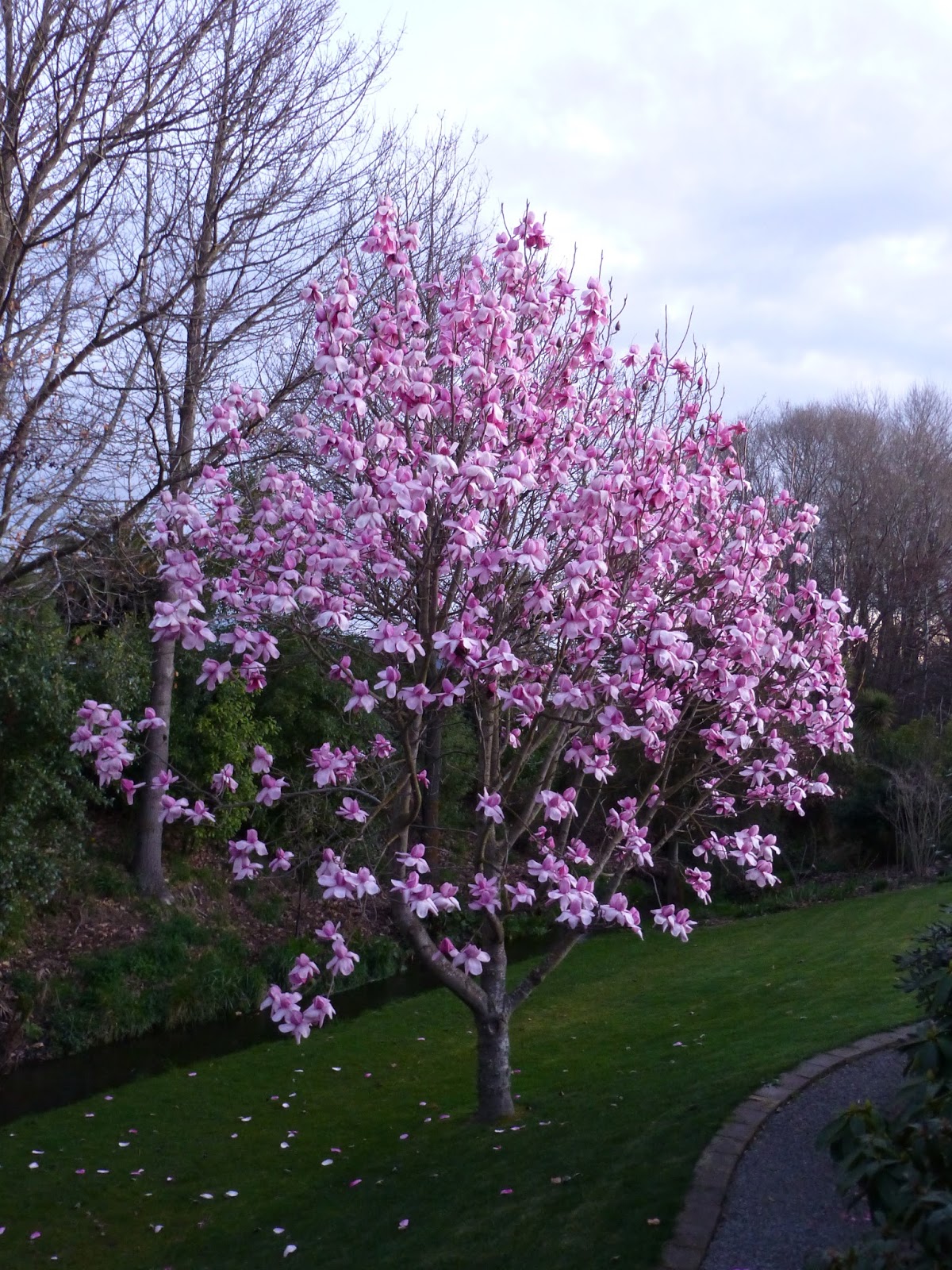
Everyone recognises the daffodil as being a major element of spring garden displays. Magnolias are just as important in the spring garden and make a fine show once established. A drive around any town or city in NZ will enable the keen observer to spot many different magnolias flowering from early spring to late spring.

One of the most important magnolias is Magnolia campbellii, but there are others equally important depending upon the effect gardeners are looking for. These include M kobus, M stellata, M x Soulangiana, M wilsonii and M seiboldii.

Magnolias belong to a large, varied genus of 125 species of deciduous and evergreen trees and shrubs from east Asia and the Americas was named after French botanist Pierre Magnol. The leaves are usually oval and smooth edged. Known for their elegant flowers and their distinctive character, magnolias are a showy group of shrubs and trees. The large spectacular flowers are generally large, fragrant and solitary with colours including white, yellow, pink or purple, and may be shaped like a funnel, cup, saucer or star.

Magnolias require deep, fertile, well-drained and aerated, mildly acid soil. The fleshy roots are fragile so the plants do not transplant readily. They thrive in sun or part shade but need protection from strong winds. The flower buds are frost sensitive. Branch structure and developing flower buds add interest in winter. Some magnolias flower when they are 2 or 3 years old and others take 10 or even 20 years to come into flower. They are well worth the wait.

M campbellii
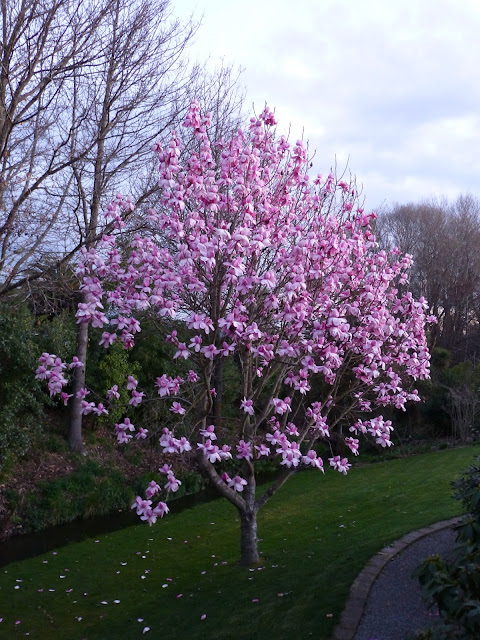
This deciduous Himalayan species eventually grows 24 m tall with a 12 m wide crown in the right conditions and there are a few this size in NZ but usually they are a lot smaller. Its slightly fragrant flowers are up to 25cm in diameter and appear on leafless branches from late winter to mid-spring. Plants raised from seed may take from 6 - 20 years to flower. It is reliably hardy. Today there are some really good NZ raised cultivars and hybrids to choose from. ‘Alba’ has pure white flowers; ‘Charles Raffill’ is white and rose purple; ‘Lanarth’ is a deeper rose purple. Magnolia ‘Vulcan’ with dark red flowers.


M.kobus
Deciduous and conical, this Japanese species can reach 10 m tall although it is not often seen this big in cultivation. Its aromatic leaves are 20 cm long and mid-green in colour.  The flowers are produced in early spring before the foliage and have long, narrow petals sometimes stained pink at the base. It can be seen planted as a street tree around Christchurch.

M. stellata (star magnolia)
This many-branched, compact, deciduous shrub from Japan grows 3 m tall and wide, with aromatic bark when young, and narrow dark green leaves. Fragrant, star­like, pure white flowers, 8 -12 cm wide, open from silky buds in late winter and early spring but its flowers are sometimes damaged by sudden frost. It flowers when quite young, and has several cultivars in shades of pink, including ‘Rosea’, ‘Waterlily’, the most prolific flowerer, has more petal and slightly larger white flowers. Though the shrub’s floral display is enchanting, its wonderful open form would recommend it even if it failed to bloom.

M soulangiana
This deciduous hybrid between Magnolia denudata and M. liliiflora first appeared in Europe in the 1820s and is now represented by many cultivars. It is an erect tree 8 m tall and 4.5 m wide, usually single trunked. The dark green leaves are tapered at the base at rounded at the tip, with a short point. Blooms in goblet, cup and saucer shapes and in white, pink or deep purple-pink appear from late winter to mid-spring, before and after the leaves emerge. ‘Alexandrina’ flowers are pure white inside, flushed rose pink outside. Goblet-shaped cultivars include ‘Lennei’, beetroot purple outside, white to pale purple inside; ‘Lennei Alba’ with pure white flowers; and ‘Rustica Rubra’, rose red outside and pink and whit inside.

M wilsonii and M seiboldii
From China, these spreading, deciduous shrubs or small trees grow up to 6 m high and wide. In late spring and early summer fragrant cup-shaped yellow flowers with red or magenta stamens hang from arching branches among narrow dark green leaves that arc velvety be h. These smallish trees represents a group of deciduous summer flowering species from China, with pendent flowers distinguishing them from the upright ones of the better know spring-flowering species. The white blooms are beautifully fragrant.

Magnolia roots arc fleshy and fragile so transplant carefully in spring. Container-grown plants are the best. Look for well-branched plants. Plant them in a fairly shallow hole - just deep enough to cover the roots - but give them enough space for the roots to develop horizontally, and leave enough space for the free in its mature size.

Provide generous water until established, and then taper off to watering during dry spells. Most well-established shrubs growing in a good garden loam can easily tolerate a week or two without water. The frequency of watering and quantity of water will be determined by a number of factors, including soil characteristics and exposure. If the soil is not naturally rich, provide an annual application of organic mulch. Provide generous fertiliser until plants are established.

Some species of magnolia arc attacked by scale. If not controlled carefully, it can cover the plant. The tree is usually able to repel any diseases if properly sited and growing vigorously. Prune magnolias as specimen ornamental trees. To avoid water shoots, any summer pruning should be very light. Remove dead wood anytime.

Magnolias make such a fantastic display that all gardeners should find a home for at least one of the fabulous plants.

Sunday, April 19, 2015

Theobroma cacao - Cocoa or Chocolate Bean

The Cocoa tree is one of 20 species of Theobroma from the warmer parts of central America. It grows into a small tree up to 5 – 6 metres with large oblong leaves. It is a nice looking small tree which was introduced into England from Trinidad in 1739. The name Theobroma is derived from Theos meaning God and Broma meaning food in reference to Cocoa being food for the gods.


The Cocoa tree produces small flowers with a pink calyx clustered directly on the trunk and older branches. The flowers are pollinated by small flies or midges. It is not the rose coloured flowers but the fruit that is in demand world wide. The large drupaceous woody fruits or pods grow to 150mm to 300 mm long and have five oblong cells in them. Each fruit, which is brown in colour, can weigh up to 500grams when ripe and have between 20 and 60 large seeds (beans) embedded in white pulp. Each seed contains a significant amount of fat or cocoa butter (40 – 50%)

The beans yield Cocoa after a process of fermentation and roasting which is used for making chocolate and cocoa for baking and drinking. 
The seeds from this plant were used as a form of currency in Aztec society (1150-1520). The Aztecs classified all of the plants in their realm and considered the seeds of the cacao tree to be extremely valuable. At times, no person in the whole Aztec kingdom was allowed to use the seeds, except the King and his closest relatives and acquaintances. This is why the botanical name for Theobroma cacao translates as ‘food of the gods’.


With the popularity growing for both Cocoa and Chocolate more planting than ever it is being grown for this world wide commodity. This tree is now cultivated in Brazil, Costa Rica, Guayaquil, Ecuador, Venezuela, Peru, Guatemala, Trinidad, and most of the other West India Islands as well as Africa, Ceylon, Samoa and regions with similar climates. 
Reported to be antiseptic, diuretic, embolic, emmenagogue, and parasiticide, cocoa is a folk remedy for alopecia, burns, cough, dry lips, eyes, fever, listlessness, malaria, nephrosis, parturition, pregnancy, rheumatism, snakebite, and wounds and cocoa butter is even used to eliminate facial wrinkles. 
The latest developments in cocoa/chocolate research include two clinical studies which indicate the flavanols found in Cocoa are beneficial to vascular health. Chocolate contains chemicals similar to those found in Red Wine, Grape Seed, and Green Tea that can aid blood circulation, reduce blood pressure, and provide other benefits. 
So not only does chocolate taste nice it is also good for you. Mind you all good things in moderation please.

Throughout the years there has been great interest in the Cocoa tree and it has featured on many postage stamps. 

There are some links to other articles at the end of this post.


Early cinderella stamp showing sponsorship by Tobler Chocolate. 


Web links

Friday, December 26, 2014

Davidia involucrata. The Dove Tree.

The dove tree, also known as handkerchief tree, is an exquisitely beautiful and exotic tree from China and is the only species in its genus and forms a rounded tree that eventually grows 10–12 metres tall. In spring pairs of long drooping, white petal-like, heavily veined bracts frame a ball-shaped cluster of stamen either red and white or black and white appear an adorn all along the branches. The bracts are held well above the leaves, making the tree look as though it were covered with white doves. When a light breeze blows the bracts sway like dove wings bring the tree to life. 


The large mulberry shaped roundish, pointed, toothed, rich green leaves white felted underneath with about 8 distinct, raised prominent veins, up to 12 centimetres long and are very attractive in their own right and cover the tree nicely. When crushed they give off a fragrant spicy scent. In NZ the form that appears to be grown is D. involucrata var. vilmoriniana which differs in that the white felt underneath the leaves is absence.  There is another species recorded, D. laeta, but this is not recorded in NZ and is subject to botanical debate as to whether or not it is a separate species.

If you plant this beautiful and exotic tree as an ornamental, keep in mind that the tree will not flower until it is nearly five years old and that some trees blossom irregularly. Planted as a shade tree, the showy bracts will be a bonus whenever they appear. They are easy to grow but may sulk a little in the first few years and are best with other deciduous trees.

Once established, most trees need little if any fertilizer provided they are growing in good garden soil. If soil is poor, or if trees are recovering from pest or disease problems, fertilizing established trees in early spring can be beneficial.

Grow dove tree in light shade in deep, rich soil enriched with peat moss or leaf mold although it will tolerate full sun if the soil is kept evenly moist. It needs shelter from wind.

The Dove tree is an excellent tree for the small to medium sized garden. Trained on a single trunk it makes a wonderful specimen and when in full flower can be almost ghostlike.


Named in honour of father Pere Armand David (1826-1900), a French missionary to China who worked there independently as China was forbidden to foreigners. He collected many new plants in the middle of the nineteenth century.  When restrictions were lifted in the 1870’s David led two scientific expeditions for the French Government. Owing to various mishaps like his boat sinking, it was many years before his collections became known.

At that time Augustine Henry, a Chinese Customs Official collected specimens in his spare time and his leave for the Royal Botanic Gardens Kew. E recorded only one solitary specimen of Davidia while exploring in the high limestone mountains of Hupeh when on leave. The tree was in flower and made a great impression on him and he secured a specimen. He was unable to go back there later as he was transferred to another province. Henry saw the potential of a great variety of plant material and urged botanists at home in England to send out a fully professional collector. In one letter he says it would be worth it for the Davidia alone.

Finally Veitch’s nursery sent E. H. Wilson (1876-1930), later known as “China” Wilson to China to collect specimens for their nursery and introduction to England. He made the long and dangerous journey from England to meet Henry and then another long journey to Hupeh. With the help of the Chinese henry had employed he found the very place and the very tree, but the tree had been cut down and was used as a door post for a house. Later one night he camped in a grove of unfamiliar trees and examined them the next morning discovering that they were Davidia’s. In 1901 he sent home a large quantity of seed to Veitch’s.
However he was not the first to send back seed. Another French missionary, Father Farges, had sent a small packet of 37 seeds to the famous French nursery DeVilmorin. Only one germinated and it grew and finally flowered in 1906. A tree from Wilson’s seed flowered in 1911.

Interestingly the leaves of the Davidia in France differed from the one in England by being smooth on the underside of the leaves. They were named as separate species D.vilmoriniana (after DeVilmorin’s Nursery) and D. involucrata. Today with modern exploration and mapping Davidia is known to occur naturally in central and southwest China from Hubei to Ganzu and south to Guzhou, Sichuan and Yunnan provinces.

Davidia is a genus of one species, Davidia involucrata, a native of western China. In the wild it grows into a lovely tall symmetrical tree up to 25 metres tall with branches that tend to grow upward into a very shapely head. However in cultivation few grow more than more than 10 metres tall. 

Propagation of new trees is by sowing the large oval seeds usually stratified for 12 months in sand and leaving them outside for the weather to break down the chemicals and seed coating so the seed will germinate. Other ways to propagate is by layering or growing from cuttings in a propagating environment. Plants raised from layers or cuttings will flower before seedling grown plants as the parts of the plants used have past their juvenile stage. It may be worth experimenting with grafting particularly taking material from the trees with the largest bracts.
Young plants are easily transplanted into the garden. Plant with good soil and a compost mulch to give it a good start.

As this is a very nicely shaped tree and a fantastic spring flowering tree take care to train it as a specimen tree on a single trunk. It is great in a partially shaded position where the white bracts really show off their colour.

It is easy to grow and it has been said it is slow to start but I have not experienced this. It prefers a strongly seasonal climate and growing with other deciduous which simulates its native habitat. It is also spring tender meaning late frost will damage new growth and in extreme cases cause the tree to suffer badly. In Canterbury a warm north westerly wind will damage the newly emerged bracts which make the outstanding display.

References

Gardeners Chronicle May 10 1967 “Davidia’s the handkerchief tree” Sheila Pim pp11

Tuesday, August 4, 2009

Theobroma cacao Cocoa or Chocolate Bean


The Cocoa tree is one of 20 species of Theobroma from the warmer parts of central America. It grows into a small tree up to 5 – 6 metres with large oblong leaves. It is a nice looking small tree which was introduced into England from Trinidad in 1739. The name Theobroma is derived from Theos meaning God and Broma meaning food in reference to Cocoa being food for the gods.

The Cocoa tree produces small flowers with a pink calyx clustered directly on the trunk and older branches. The flowers are pollinated by small flies or midges. It is not the rose coloured flowers but the fruit that is in demand world wide. The large drupaceous woody fruits or pods grow to 150mm to 300 mm long and have five oblong cells in them. Each fruit, which is brown in colour, can weigh up to 500grams when ripe and have between 20 and 60 large seeds (beans) embedded in white pulp
Each seed contains a significant amount of fat or cocoa butter (40 – 50%)

The beans yield Cocoa after a process of fermentation and roasting which is used for making chocolate and cocoa for baking and drinking.
The seeds from this plant were used as a form of currency in Aztec society (1150-1520). The Aztecs classified all of the plants in their realm and considered the seeds of the cacao tree to be extremely valuable. At times, no person in the whole Aztec kingdom was allowed to use the seeds, except the King and his closest relatives and acquaintances. This is why the botanical name for Theobroma cacao translates as ‘food of the gods’.
With the popularity growing for both Cocoa and Chocolate more planting than ever it is being grown for this world wide commodity. This tree is now cultivated in Brazil, Costa Rica, Guayaquil, Ecuador, Venezuela, Peru, Guatemala, Trinidad, and most of the other West India Islands as well as Africa, Ceylon, Samoa and regions with similar climates.
Reported to be antiseptic, diuretic, embolic, emmenagogue, and parasiticide, cocoa is a folk remedy for alopecia, burns, cough, dry lips, eyes, fever, listlessness, malaria, nephrosis, parturition, pregnancy, rheumatism, snakebite, and wounds and cocoa butter is even used to eliminate facial wrinkles.
The latest developments in cocoa/chocolate research include two clinical studies which indicate the flavanols found in Cocoa are beneficial to vascular health. Chocolate contains chemicals similar to those found in Red Wine, Grape Seed, and Green Tea that can aid blood circulation, reduce blood pressure, and provide other benefits.
So not only does chocolate taste nice it is also good for you. Mind you all good things in moderation please.

Monday, January 26, 2009

Davidia involucrata The Dove Tree


The dove tree, also known as handkerchief tree, is an exquisitely beautiful and exotic tree from China and is the only species in its genus and forms a rounded tree that eventually grows 10–12 metres tall. In spring pairs of long white petal-like bracts frame a ball-shaped cluster of flowers. The bracts are held well above the leaves, making the tree look as though it were covered with white doves. The large roundish, pointed, rich green leaves are up to 12 centimetres long and are very attractive in their own right.

If you plant this beautiful and exotic tree as an ornamental, keep in mind that the tree will not flower until it is nearly ten years old and that some trees blossom irregularly. If you plant it as a shade tree, the showy bracts will be a bonus whenever they appear.
Once established, most trees need little if any fertilizer provided they are growing in good garden soil. If soil is poor, or if trees are recovering from pest or disease problems, fertilizing established trees in early spring can be beneficial.
Grow dove tree in light shade in deep, rich soil enriched with peat moss or leaf mold. Although it will tolerate full sun if the soil is kept evenly moist. They need shelter from wind.
The Dove tree or handkerchief tree is an excellent tree for the small to medium sized garden. Trained on a single trunk it makes a wonderful specimen and when in full flower can be almost ghostlike.