Showing posts with label NZ Tree. Show all posts

Sunday, January 3, 2016

Peel Forest - Near Geraldine Mid South Canterbury.

There are many walks in the area. Two that can be completed in an afternoon are Emily Falls Walk and Dennistoun Bush Walk. Both very different.

After driving through the small (tiny) picturesque village of Peel Forest at the base of the Southern Alps foothills turn left onto Blandswood Road and then at the end of the seal turn right onto Lookout Road and onto the car park.

Emily Falls Walk. Lovely bush and listen to the bellbirds singing.

Walking up the road to the track entrance the air is filled with the ringing sound of the Bellbirds singing in the trees. Starting on the track is easy but soon winds its way upwards for about 15 minutes to the top of the ridge. On the way large 'old man' Fuchsia (Fuchsia excorticata) hang over the track and at this time of year are in full flower. Many ferns line the walking track along the way. 

At the top of the ridge the track divides to go to Emily Falls or Rata Falls.

Taking the Emily Falls track  defend to the steam and walk up stream for about 100 metres. With little recent rain you wont get your feet wet but with gentle and careful rock hopping rejoin the track to the Falls. Lovely bush area and nice stands of South Island Kowhai ( Sophora microphylla).

Return the same way and return time about 1.30 hours to 2 hours.

Photos


"Old Man" Fuschia - Flakey orange bark


Emily Falls 


Dennistoun Bush Walk.  Spectacular 1000 year old trees.

This excellent flat bush walk is found on Blandwood Road before heading up to the Emily Falls car park. A large sign on the  side of the rad  with a nice  mown grease picnic area makes it easy to spot.

A wide waking track leaves the panic area and forks into a circular track around the area.

Within a few metres of entering the track gigantic Totara, Kahikatea and Matai trees are encountered. These extra large trees are remnants for the extensive logging carried out in the 1800’s. Now about 1000 years old these are spectacular in size, form and structure. Not just one or two but many trees are scattered through this reserve.

Apart from the walk and trees take a very short side trip to the saw pit area and imagine to work that early foresters undertook to fell these large trees and  hand mill them into usable  timber.

Enjoy the walk amongst these giants, enjoy the  singing of the bellbirds.


 Totara
 Totara
 Totara
 Kahikatea

 Matai

Saw Pit where felled logs were cut into usable timber


Totara Video

The Giant Trees

To help  with identifying the trees the short description below will make it easy. The leaves of these trees are all different but as they are large stand back and look up at them and identify the leaves against the sky.

There are a number of useful links at the end of each description.


Totara, Podocarpus totara. Easily recognises by its tough green spiked leaves about 25mm long and 4mm wide and its stringy bark totara grow into very large diameter trees up to 30m high. Here on this walk are excellent examples of very large specimens. 

"One of the largest trees in the forest, its timber was prized by Maori as being the best for building their massive war canoes, and was also the main timber used for carving. Until more recent times it was also valued for bridge and wharf construction, as well as a wide variety of other uses ... Ancient Maori custom demanded that when a totara tree was felled for timber a young seedling had to he planted in its place in order to appease Tane, the god of the forest, for removing one of his 'children' " (Metcalf 2002).

Kahikatea, Dacrycarpus dacrydioides, (previously Podocarpus dacrydioides) is the tallest native tree in New Zealand. The one growing here are certainly tall and criss cross the track with their large surface roots.

It can be recognised by the leaves which are very small being about 1mm wide and 3mm long tightly packed along the stems. The colour may  change for a large purplish green to an olive green. The trunk has a nice flakey pattern to it with approximately 75mm diameter pieces of bark flaking off at different times. Large rounded surface roots cover the ground around the tree.


Matai, Prumnopitys taxifolia, (previously Podocarps taxifolia). The tall Matai has leaves about 10 - 15 mm long and 2mm wide and a dark green colour. It also has surface roots.


Wednesday, February 11, 2015

Southern Rata - Red Glow on the Mountainside

Metrosideros umbellata Southern Rata or Ironwood

The best and easiest place to see the Southern Rata in full flower is on the western slopes of Arthur’s Pass in the South Island on the western slopes of the Southern Alps between the summit and historic Otira township. Arthur's Pass is also a great place to walk amongst the mountain flora.


Waitangi Day (6 February) is a great calendar date to remind people to head for this area to see the large round headed trees in full flower with their blood red flowers covering the tops of the trees.

Unfortunately it does not flower really well each year. Some suggest it is every 3 -4 years although some trees can be found in flower every year. When most trees are in full flower it is a spectacular site covering the steep mountain sides with a red glow.

This tree grows up to 18 metres tall with a trunk up to 1 metre in diameter although it can easily be multi trunked from the base. Once above the surrounding trees it forms a dense round headed tree and flowers appear all over the rounded  canopy.


Its leaves are tough and leathery, dark green above and pale green below yet each leaf is an attractive lanceolate shape about 4 -7.5cm long and 1.2 - 2 cm wide. The underside is covered in oil glands and the midriff is easily seen. Around the edge of the leaf is a conspicuous continuous vein.

The blood red flowers feature short petals and sepals while the up to 2.5 cm long anthers are also blood red and numerous. The individual flowers are borne on cymes (a special flat topped grouping of flowers)  with the stamen providing most of the colour as the sepals and petals are quite small.


Southern Rata is found from Kaitaia in the North Island to Stewart Island on the wetter western side of both islands and grows from near sea level to 1050 metres.

Its timber is very strong as it has to withstand  very strong winds and other weather forces. It does not rot either.


If grown in the garden it takes many years to flower. Some experiments were undertaken to propagate it from cuttings of flowering shoots  but unfortunately there are no results of this work. More research on this would be welcome.

In the wild it is a spectacular tree to see flowering. Well worth the wait for a good year and the trip to Arthur's Pass. While there take a day walk up the Bealey Spur .


Sunday, January 25, 2015

Kaituna Vally Banks Peninsula

Kaituna Valley has always been popular for recreational walking especially up through the reserve to the Mt Herbert Walkway along the crater Rim.

Recently the last farm on the road has been retired to revert to native bush and plants. The owners have had the whole farm convented with the Banks Peninsula Conservation Trust.

The farm road to the crater Rim Walkway is now open to the public to walk right up the last part of the valley to the Crater Rim. The Crater Rim Walkway follows the southern edge of a long extinct volcano. The sea now comes into part of this to form Lyttleton Port of Christchurch.

here are some photographs taken on our walk last week.


Dacrycarpus dacrydioides - Kahikatea 
Kaituna Reserve before the start of the walk


Kahiatea at ground level showing the base of this  tree probably 4-500 years old.


Kahikatea tree above the surround forest


Kahikatea on the right and Matai (Prumnopitys taxifolia) on the left 


Podocarpus totara - Totara


Looking up to the Crater Rim from about 75% of the way there


At the top looking down on Te Waihora (Lake Ellesmere) and Kaitorete Spit


Totara Logs left to weather after many years - an erie but interesting sight


Panorama of Kaituna Valley


Kaituna Valley


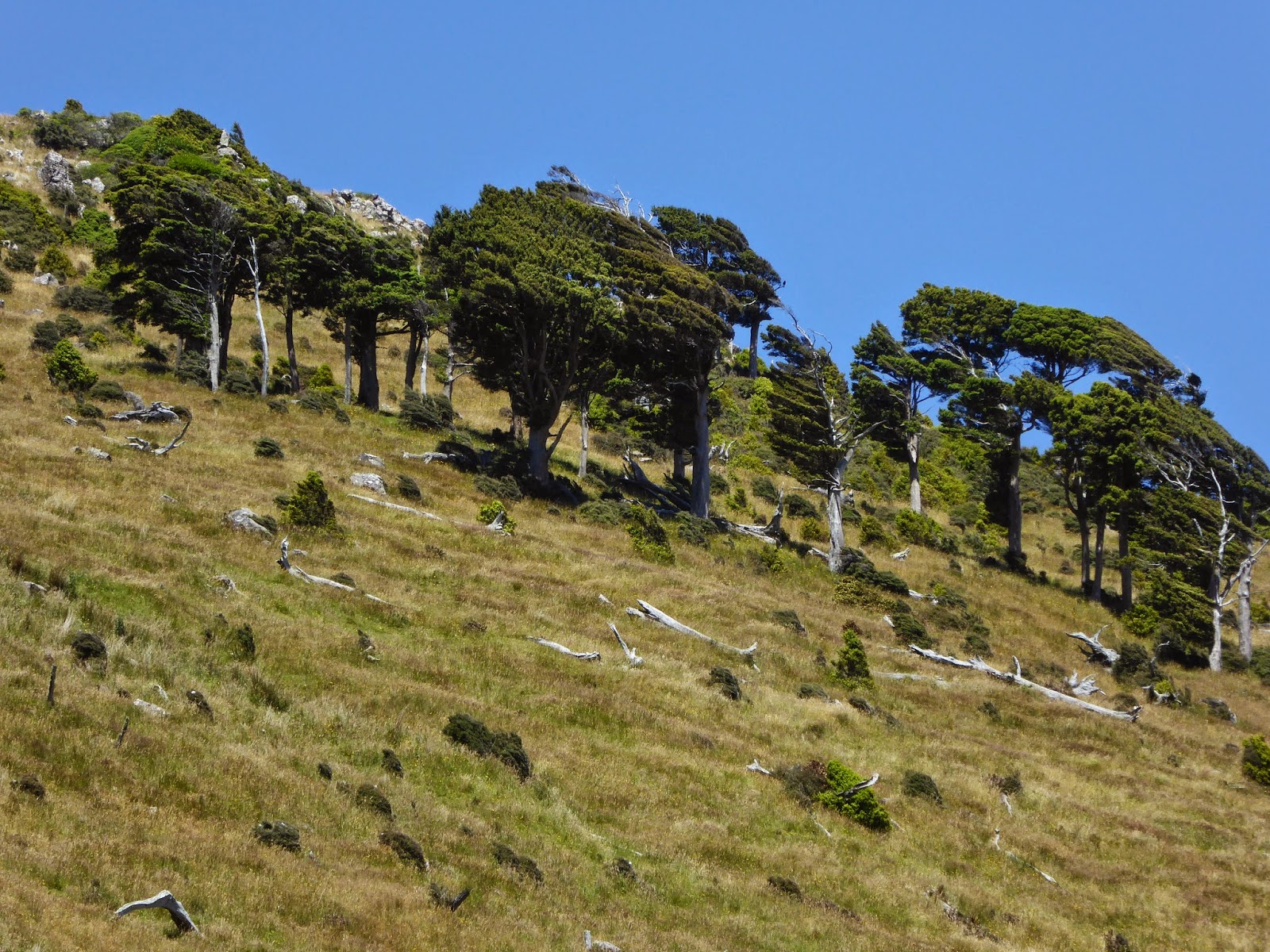
Totara trees sculptured by the southerly wind


Totara trees still standing guard over the valley.

Thursday, January 8, 2015

NZ Plants on Stamps 1999

By Alan Jolliffe

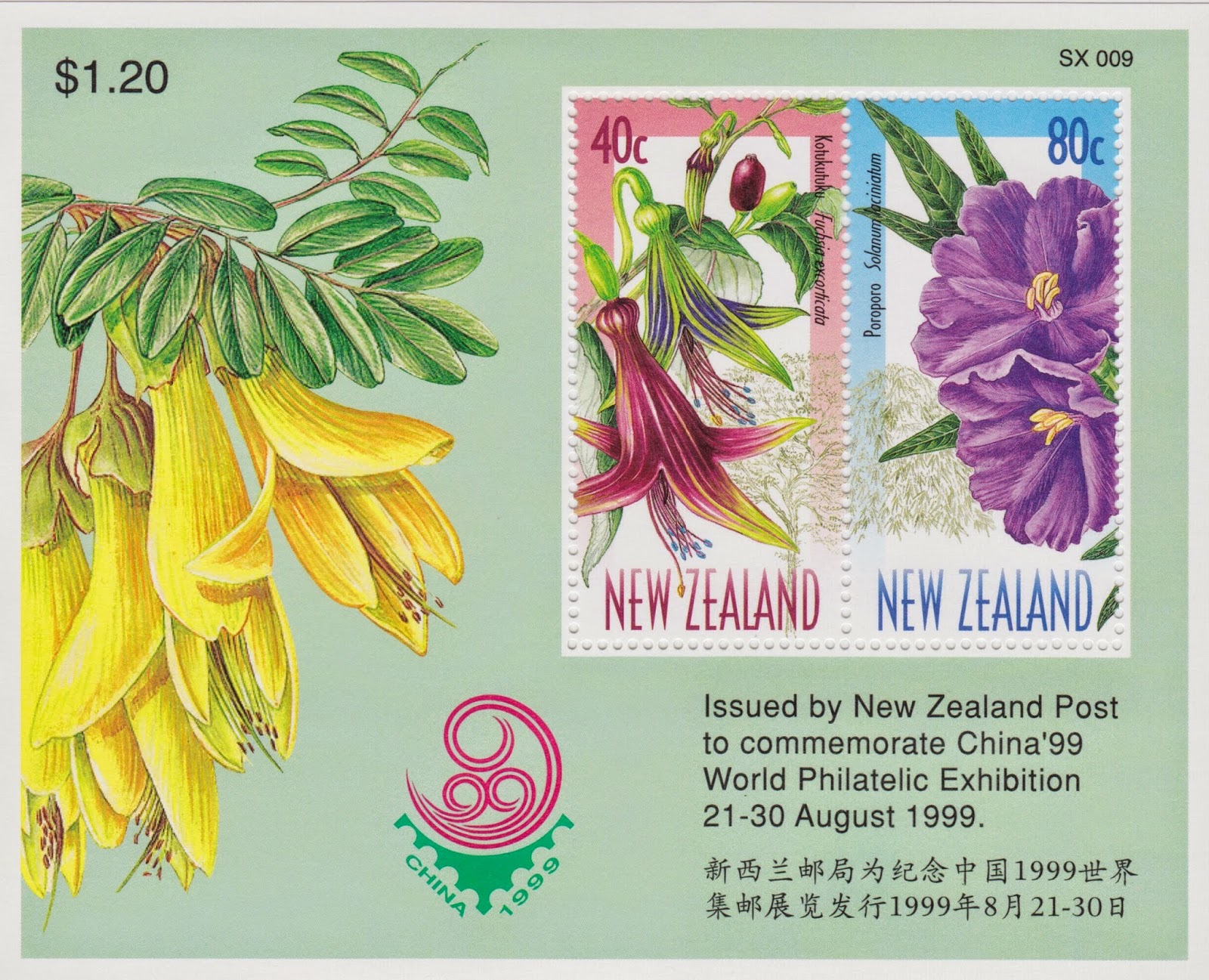
Released on 13 January 1999 this set of six stamps features six well-known NZ Native plants in full living colour. A red contrast to those first stamps that feature plants.

40c – Kotutuku – Fuchsia excorticata. Found throughout NZ in open forest in lower altitudes where there is a mixed range of trees, shrubs and plants. It is very distinctive with its light reddish brown coloured peeling bark falling off thick sturdy trunks and branches. The kotukutuku is the largest growing (up to 14 metres) fuchsia in the world but has one of the smallest flowers. The flowers are only 20-30 mm long and hang downward off young stems or even protrude from very old branches. They are green with purple streaks and when pollination turn dark red with age. Small dark fruits filled with seed follow.


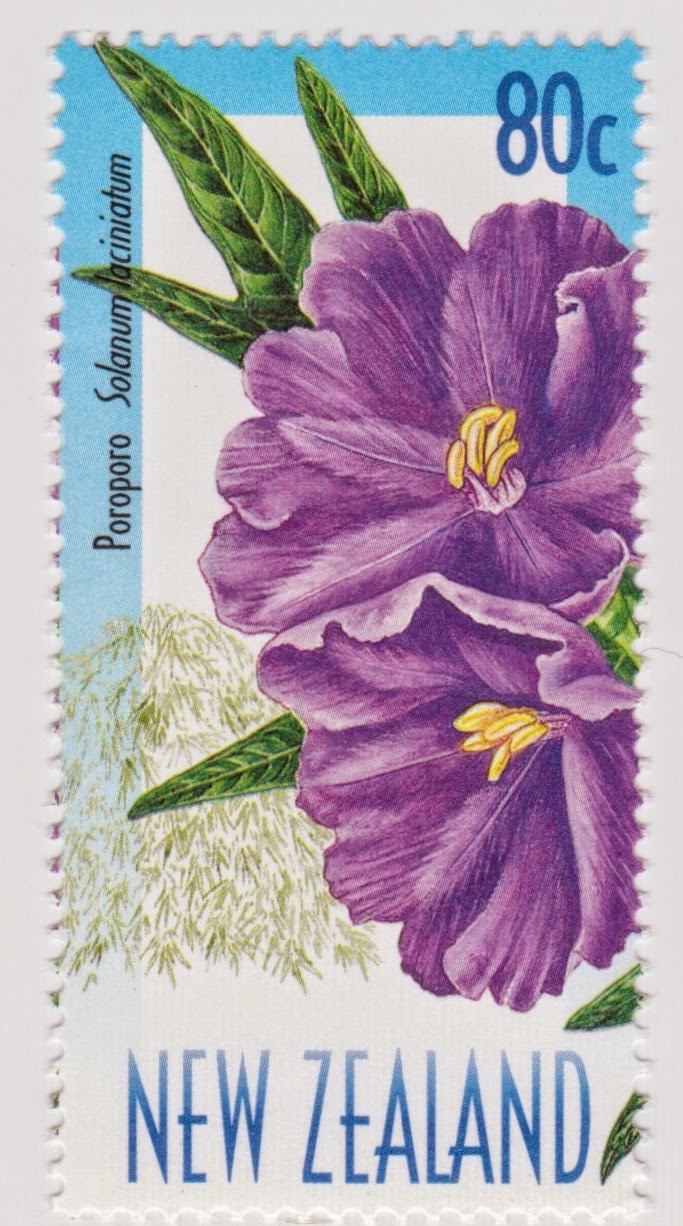
80c – Poroporo – Solanum laciniatum. This striking plant is found throughout NZ from Auckland to Dunedin. Its dark blue-purple flowers appear from September to April. In nature it grows in scrubs and lowland forest margins but will survive quite well out in the open. It is a shining, soft wooded, openly branched tree with purplish stems and leaf veins. It will reach a height of 3m. Belonging to the Solanaceae family it has a number of chemical properties. At one stage it was field trailed as a potential crop from which would be harvested a chemical to be used in a contraceptive pill.


$1.00 – Kowhai – Sophora tetraptera. Correctly known as the NZ Kowhai this is traditionally regarded as NZ’s National Flower. Its golden yellow flowers can be seen up and down the country from August to November. The flowers are about 5 cm long and each one is filled with nectar, which is a favourite food of some Native birds namely, the bellbird and Tui.

It’s main native habitat is growing alongside streams and lowland forest margins from East Cape to the Rhine Ranges. It is now planted in gardens and parks up and down the country.

The South Island Kowhai (S microphylla) has smaller leaves and grows through a juvenile stage before flowering. 

Both are reputed to have medicinal properties.


$1.20 – Weeping Broom – Carmichaelia stevensonii. 

One of NZ’s unsung heroes of the plant world and one that has been destroyed on many areas through each of knowledge and confusion with introduced broom.

The weeping broom is a distinctive leafless tree that is only found naturally in Eastern Marlborough. It is now protected within a number of reserve areas.

It differs from other brooms in that it forms a small tree and the flowers are pale lavender to lilac in colour. The darker colour coming from the intense striping on the flowers. Large clusters of flowers are produced which hang from the branches like small branches of grapes from November to January.


$1.50 – Teteaweka – Olearia angustifolia.

This unusual plant grows naturally along the coastal areas of Southland and Foveaux straight and on the Coastal headlands of Stewart Island. Other similar species grow in the Chatham Islands.

This tree daisy is notable for its large, solitary scented flowers head up to 5 cm across. The leaves are evenly toothed and covered with grey hairs (tomentums) on the underside.


$1.80 – Southern Rata – Metrosideros umbellata.

In midsummer this tree is fabulous in the wilds of the South Island. Otira Gorge in February is a beautiful sight and it’s brilliant profusion of crimson and blood red flowers is unforgettable.

Regular visitors to the Otira Gorge in February will see bands of colour slowly creeping up the Mountains as the lower level trees flower first and those growing at a higher altitude flower later.


The flower colour is brighter than Pohutakawa – its close relation and is a nicer tree for cultivation.