Follow this link to the article
"The Art and Science of Gardening", Gardens, Horticulture, Plants, Garden History, Conservation, Garden Tourism.
Showing posts with label Stamps. Show all posts
Friday, July 17, 2015
Monday, May 18, 2015
Sunday, April 19, 2015
Theobroma cacao - Cocoa or Chocolate Bean
The Cocoa tree is one of 20 species of Theobroma from the warmer parts of central America. It grows into a small tree up to 5 – 6 metres with large oblong leaves. It is a nice looking small tree which was introduced into England from Trinidad in 1739. The name Theobroma is derived from Theos meaning God and Broma meaning food in reference to Cocoa being food for the gods.
The Cocoa tree produces small flowers with a pink calyx clustered directly on the trunk and older branches. The flowers are pollinated by small flies or midges. It is not the rose coloured flowers but the fruit that is in demand world wide. The large drupaceous woody fruits or pods grow to 150mm to 300 mm long and have five oblong cells in them. Each fruit, which is brown in colour, can weigh up to 500grams when ripe and have between 20 and 60 large seeds (beans) embedded in white pulp. Each seed contains a significant amount of fat or cocoa butter (40 – 50%)
The beans yield Cocoa after a process of fermentation and roasting which is used for making chocolate and cocoa for baking and drinking.
The seeds from this plant were used as a form of currency in Aztec society (1150-1520). The Aztecs classified all of the plants in their realm and considered the seeds of the cacao tree to be extremely valuable. At times, no person in the whole Aztec kingdom was allowed to use the seeds, except the King and his closest relatives and acquaintances. This is why the botanical name for Theobroma cacao translates as ‘food of the gods’.
With the popularity growing for both Cocoa and Chocolate more planting than ever it is being grown for this world wide commodity. This tree is now cultivated in Brazil, Costa Rica, Guayaquil, Ecuador, Venezuela, Peru, Guatemala, Trinidad, and most of the other West India Islands as well as Africa, Ceylon, Samoa and regions with similar climates.
Reported to be antiseptic, diuretic, embolic, emmenagogue, and parasiticide, cocoa is a folk remedy for alopecia, burns, cough, dry lips, eyes, fever, listlessness, malaria, nephrosis, parturition, pregnancy, rheumatism, snakebite, and wounds and cocoa butter is even used to eliminate facial wrinkles.
The latest developments in cocoa/chocolate research include two clinical studies which indicate the flavanols found in Cocoa are beneficial to vascular health. Chocolate contains chemicals similar to those found in Red Wine, Grape Seed, and Green Tea that can aid blood circulation, reduce blood pressure, and provide other benefits.
So not only does chocolate taste nice it is also good for you. Mind you all good things in moderation please.
Throughout the years there has been great interest in the Cocoa tree and it has featured on many postage stamps.
There are some links to other articles at the end of this post.
Web links
Thursday, January 8, 2015
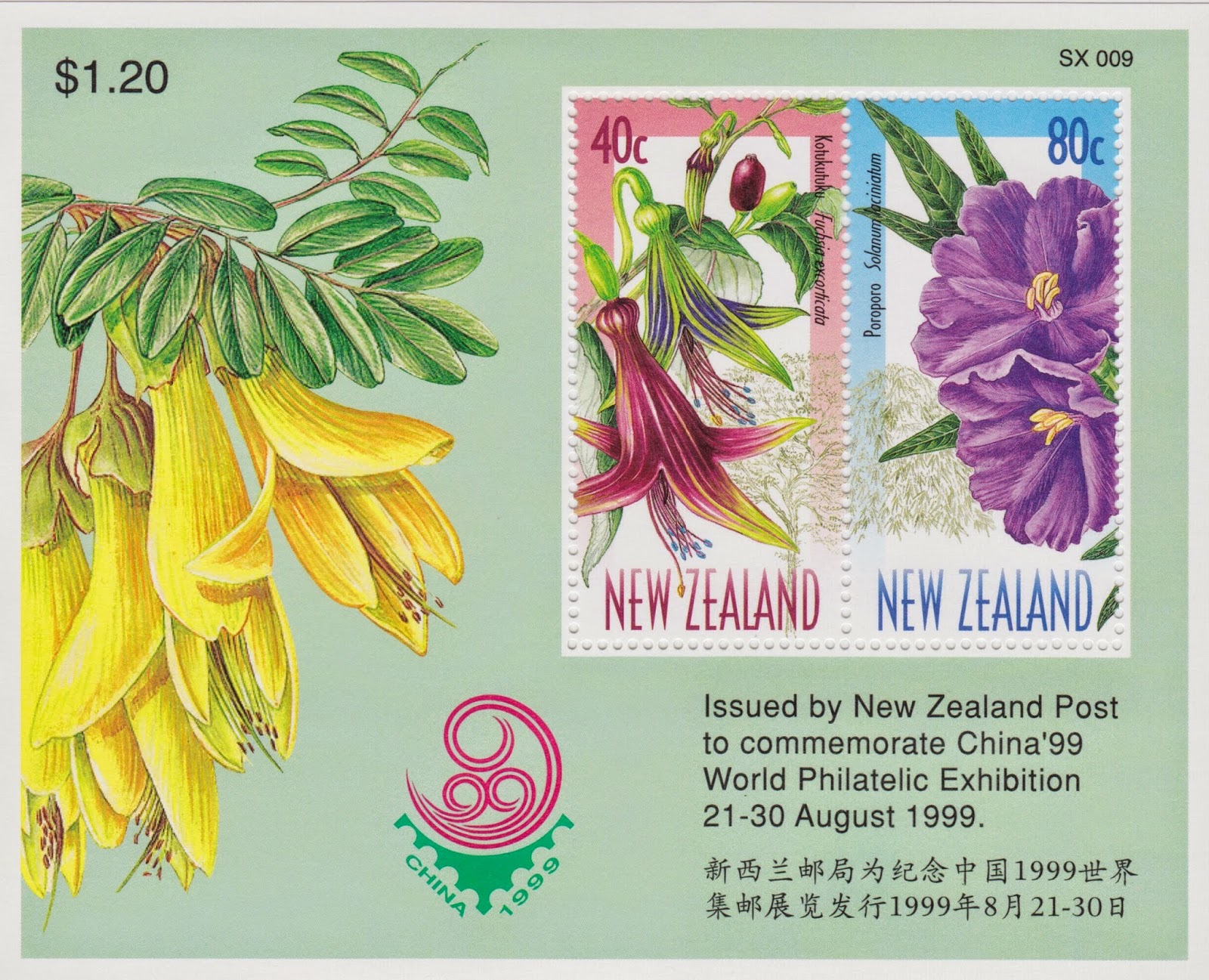
NZ Plants on Stamps 1999
By Alan Jolliffe
Released on 13 January 1999 this set of six stamps features six well-known NZ Native plants in full living colour. A red contrast to those first stamps that feature plants.
40c – Kotutuku – Fuchsia excorticata. Found throughout NZ in open forest in lower altitudes where there is a mixed range of trees, shrubs and plants. It is very distinctive with its light reddish brown coloured peeling bark falling off thick sturdy trunks and branches. The kotukutuku is the largest growing (up to 14 metres) fuchsia in the world but has one of the smallest flowers. The flowers are only 20-30 mm long and hang downward off young stems or even protrude from very old branches. They are green with purple streaks and when pollination turn dark red with age. Small dark fruits filled with seed follow.
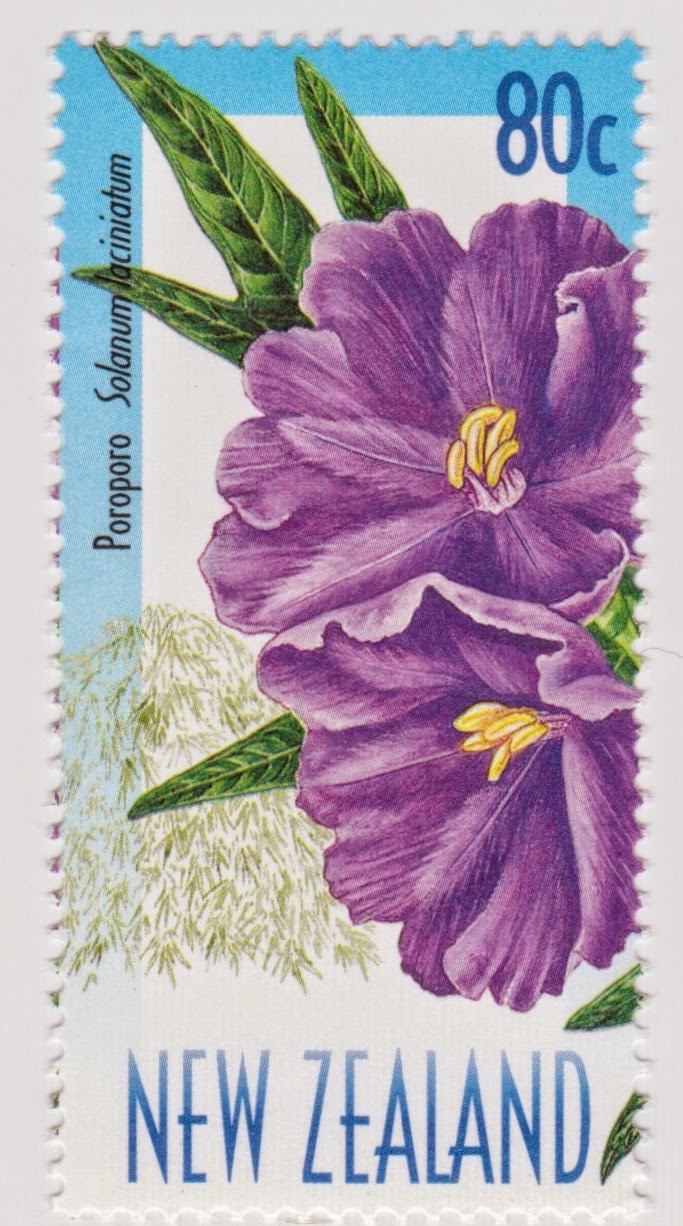
80c – Poroporo – Solanum laciniatum. This striking plant is found throughout NZ from Auckland to Dunedin. Its dark blue-purple flowers appear from September to April. In nature it grows in scrubs and lowland forest margins but will survive quite well out in the open. It is a shining, soft wooded, openly branched tree with purplish stems and leaf veins. It will reach a height of 3m. Belonging to the Solanaceae family it has a number of chemical properties. At one stage it was field trailed as a potential crop from which would be harvested a chemical to be used in a contraceptive pill.
$1.00 – Kowhai – Sophora tetraptera. Correctly known as the NZ Kowhai this is traditionally regarded as NZ’s National Flower. Its golden yellow flowers can be seen up and down the country from August to November. The flowers are about 5 cm long and each one is filled with nectar, which is a favourite food of some Native birds namely, the bellbird and Tui.
It’s main native habitat is growing alongside streams and lowland forest margins from East Cape to the Rhine Ranges. It is now planted in gardens and parks up and down the country.
The South Island Kowhai (S microphylla) has smaller leaves and grows through a juvenile stage before flowering.
Both are reputed to have medicinal properties.
$1.20 – Weeping Broom – Carmichaelia stevensonii.
One of NZ’s unsung heroes of the plant world and one that has been destroyed on many areas through each of knowledge and confusion with introduced broom.
The weeping broom is a distinctive leafless tree that is only found naturally in Eastern Marlborough. It is now protected within a number of reserve areas.
It differs from other brooms in that it forms a small tree and the flowers are pale lavender to lilac in colour. The darker colour coming from the intense striping on the flowers. Large clusters of flowers are produced which hang from the branches like small branches of grapes from November to January.
$1.50 – Teteaweka – Olearia angustifolia.
This unusual plant grows naturally along the coastal areas of Southland and Foveaux straight and on the Coastal headlands of Stewart Island. Other similar species grow in the Chatham Islands.
This tree daisy is notable for its large, solitary scented flowers head up to 5 cm across. The leaves are evenly toothed and covered with grey hairs (tomentums) on the underside.
$1.80 – Southern Rata – Metrosideros umbellata.
In midsummer this tree is fabulous in the wilds of the South Island. Otira Gorge in February is a beautiful sight and it’s brilliant profusion of crimson and blood red flowers is unforgettable.
Regular visitors to the Otira Gorge in February will see bands of colour slowly creeping up the Mountains as the lower level trees flower first and those growing at a higher altitude flower later.
The flower colour is brighter than Pohutakawa – its close relation and is a nicer tree for cultivation.
Friday, January 2, 2015
Stamps of Liechtenstein: Bog Flowers (2014)
In its most recent stamp issue, Philately continues the popular definitive stamp series with flower motifs. The self-adhesive stamps designed by Stefan Erne depict three indigenous bog flowers: the Siberian sword lily (value: CHF 1.00), the Marsh Grass-of-Parnassus (value: 2.80) and the bog-bean, or buckbean (value: CHF 3.60).
Although the Siberian sword lily (lat: Iris sibirica) is in steady decline, it can still be found in Liechtenstein in marshlands and shallow swamps. This light-loving plant with its large violet-blue blossoms bedecks large areas of the Ruggeller Riet in the months of May and June. This Iridaceae, also known under its synonym Blue Flag, grows to a height of 40 to 80 centimetres and, in contrast to other conspecifics, does not have sword-shaped but rather slender grass-like leaves. The new stamp is also Liechtenstein’s contribution to this year’s joint issue of SEPAC. In this organisation, 14 small European postal administrations have joined forces and regularly issue stamps on common themes.
The Marsh Grass-of-Parnassus (lat: Parnassia palustris), also called Student’s Rose, thrives in the marshlands from the valleys up to the mountainous regions. In Central Europe it is the sole representative of its plant family, the Parnassiaceae. Its white petals are threaded with colourless longitudinal veins; its edge is generally smooth. In earlier times the plant was used among other things as a remedy for heart palpitations.
The buckbean or bog-bean (lat: Menyanthes trifoliate) is still used, especially as an appetite stimulant and digestion aid, which explains why it is a component of many ‘digestive’ bitters. There are only three places where this endangered gentian with its white, bearded petals can now be found in Liechtenstein. However, it has been successfully planted in several other places. The buckbean, or bog-bean, has a life span of up to 30 years.
Source: WOPA Stamps
Source: WOPA Stamps
Subscribe to:
Posts (Atom)